News
Exploring ocean DNA with Saara Suominen - A conversation on eDNA, science, and inspiration
11 February 2025
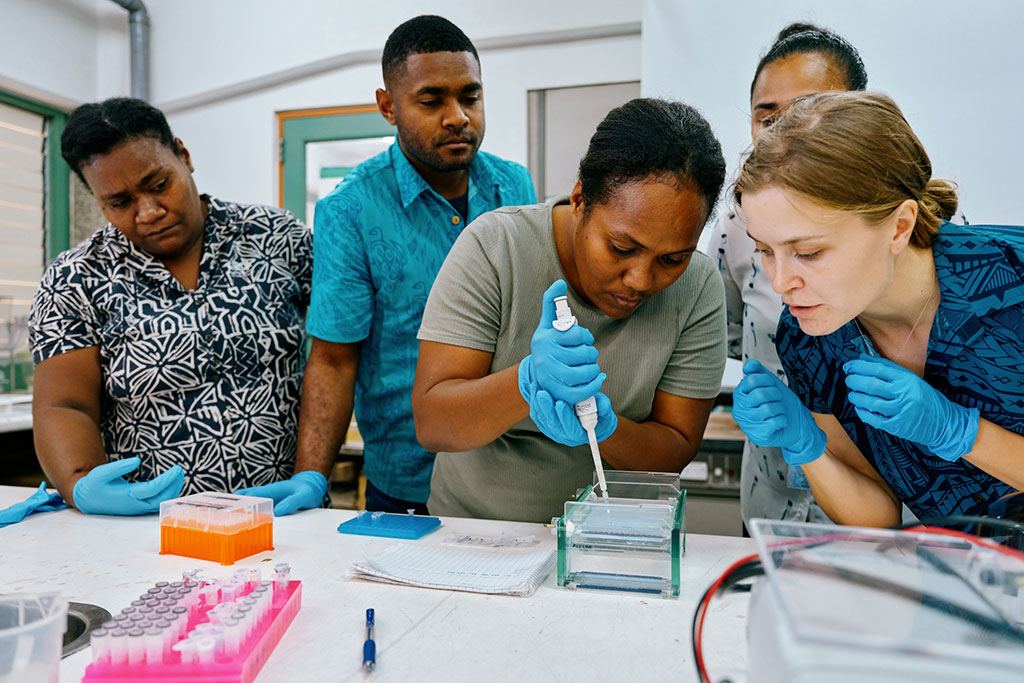
To celebrate Women and Girls in Science Day, we spoke with Saara Suominen, a scientific officer at OBIS specializing in genetic data. From her fascination with marine life to her work on environmental DNA, Saara shares her journey, insights into cutting-edge marine science, and advice for young women interested in scientific careers.
Happy to have you here, Saara! Can you tell us about your role at OBIS?
Saara Suominen: I am a scientific officer at OBIS, specializing in integrating genetic information—mainly environmental DNA (eDNA)—into our biodiversity database, enhancing it with genetic material collected from ocean environments. A big part of my work involves training, promoting, and advancing the use of eDNA in marine research. I also directly contribute to various international projects, including the recently completed PacMAN project that granted Fiji “marine invasive species monitoring-ready” status, and the “UNESCO eDNA expeditions”, as well as EU-funded projects for increasing eDNA data sharing, ensuring data accessibility on both a European and global scale.
eDNA is revolutionizing marine biodiversity observations. Instead of relying on traditional methods—like sending divers, underwater robots, or taking visual surveys—we can now analyze DNA from water samples to identify species present in a given area. eDNA allows us to gather more data more efficiently, especially when monitoring biodiversity in remote areas, tracking endangered species, and detecting invasive species early.
eDNA is a great complement to other biodiversity observing methods, with an amazing potential for expanding our knowledge of ocean life.
What inspired you to enter this field?
My passion for the ocean started really early! I was captivated by marine life as a kid, and I always knew I wanted to work in ocean sciences. I grew up next to a lake, and I spent a lot of time around the water. This definitely influenced my love for aquatic environments and inspired my future career! As a child, I’ve always been drawn to understanding how things work—why natural processes happen, how we can study them, and how knowledge can be applied. I’ve also been very interested in the connection between science and society—not just theoretical research but how scientific findings can inform decisions and policies.
I started my academic journey in microbiology, studying tiny organisms that are crucial in nutrient cycles. I was fascinated by the impact microorganisms have on our planet. Through that work, I learned about molecular methods—using DNA to study microbes we couldn’t culture in labs. But I kept returning to marine science, applying my interest in microbial ecology and molecular biology to the ocean. After finishing my PhD, I wanted to apply my knowledge to contribute to solving social issues, and eDNA was the perfect fit! It was an emerging field that combined my genetics skills with my love for marine science. When I joined OBIS, I realized—yes, this is exactly where I’m meant to be: I could link science and impact! It’s always felt like something is missing between scientific knowledge and decision-making. We have so much data and so many ways to collect information. Yet, that information doesn’t always reach policymakers or communities in a way that drives action. I was drawn to that intersection of science and policy, and OBIS allows me to contribute to that.
Since joining OBIS, was there a moment, an epiphany, when you thought, “Now I’m at the right place”?
Oh yes! One of my first projects at OBIS was PacMAN, which focused on invasive species in Fiji. It was challenging because we were in the middle of the pandemic, dealing with lockdowns and logistical difficulties. But when things finally started moving, seeing the local teams collecting samples, getting results, and making progress was incredibly rewarding. The UNESCO eDNA Expeditions project was also another fantastic moment. The project was a premiere for us at such a scale: we combined eDNA with citizen science to address biodiversity issues. We tasked young volunteers with observing 21 Marine World Heritage sites worldwide to monitor biodiversity. We deployed robust but simple protocols for sampling, enabling volunteers as young as 7 to participate! Seeing how powerful and impactful citizen science can be was inspiring. It was amazing to see how these kids could, for real, contribute to biodiversity monitoring. The photos and stories of people engaging with their local marine environments were truly wonderful. During this project, I felt that connection between science, data, and communities, and I thought I was part of it.
What does a typical day as an OBIS genetic data expert look like?
It’s not all fieldwork and adventure, but it’s captivating! eDNA and biodiversity molecular observations are fast-advancing fields where methods, processes and technologies evolve at a lightning speed. I don’t do fieldwork myself—it’s mostly the local communities we collaborate with who collect samples. I’d love to do more, but my role is focused on coordinating projects, developing methodologies, and ensuring the data is reliable and accessible. A lot of my work happens on the computer—analyzing data, coordinating projects, and troubleshooting issues. I spend time in meetings with different research teams, reviewing datasets and technologies, and developing new methodologies for genetic data integration. I also present research and contribute to scientific discussions.
Where do you see ocean science heading in the next decade? Could you think about emerging trends young scientists should watch?
There are some exciting developments! Metagenomics is gaining momentum—right now, we rely on DNA barcoding, which targets specific genes. But in the future, we might sequence entire genomes from environmental samples, giving us a much broader and deeper understanding of ecosystems. Another big trend is AI and machine learning in biodiversity research. We handle huge datasets, and AI can help us detect patterns, predict trends, and improve analysis accuracy.
And, of course, automation—using autonomous vehicles for sampling, increasing accessibility to data, and reducing the need for costly expeditions.
What advice would you give to young women and girls thinking about embarking on a scientific career?
Trust yourself. Believe that you can do this, and follow your passion. Don’t let self-doubt hold you back. Science needs diverse perspectives, and there is a place for you in this field.