News
eDNA Expeditions Phase II Launches at UNOC3 - A Global Community Effort to Map Marine Life with DNA
12 June 2025
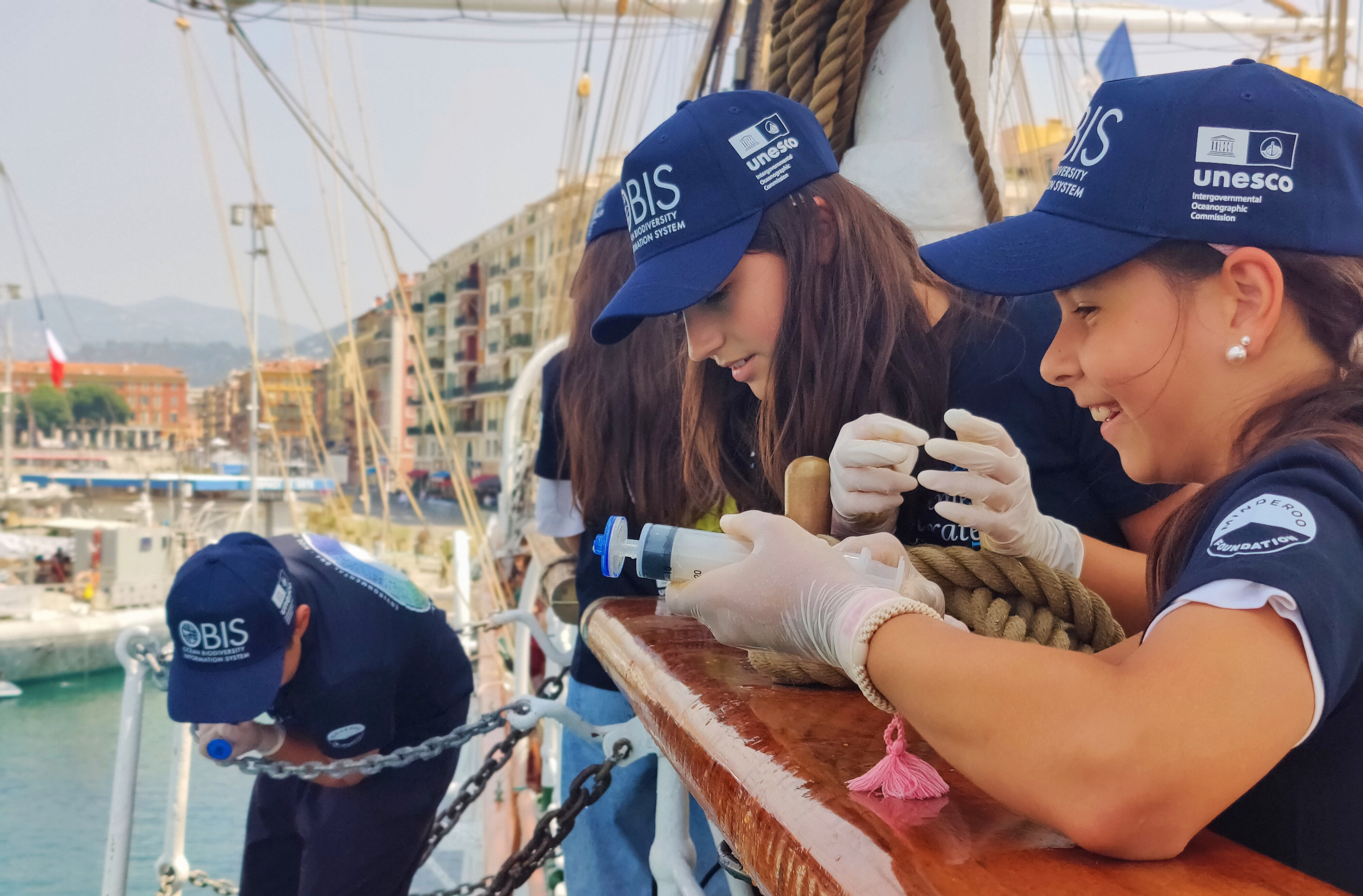 Two 6th-graders of the “Méditerrannée” class from the Collège Ségurane in Nice take part in the sampling operation kicking off the eDNA Expeditions Phase II at the third United Nations Ocean Conference on 12 June 2025. Photo: OBIS / Ward Appeltans
Phase II of the eDNA Expeditions is a new global campaign that empowers communities to monitor marine biodiversity with simple, science-based kits, boosting engagement for Ocean action.
On 12 June 2025, aboard the historic Norwegian tall ship Statsraad Lehmkuhl in the port of Nice, eDNA Expeditions Phase II officially launched. This OBIS-powered global campaign, supported by Minderoo Foundation, brings together scientists, educators, and citizens to monitor marine life in Marine Protected Areas around the world using environmental DNA (eDNA).
Building on the success of Phase I—which mobilized 250 citizen scientists across 21 UNESCO World Heritage Marine Sites and identified over 4,000 marine species from 400 samples—Phase II of the eDNA Expeditions aims to establish long-term molecular biodiversity monitoring at 25 marine protected areas, with a target of 2,500 samples, six times more than in the first phase. “As molecular observation becomes a globally viable and widely adopted tool, the eDNA Expeditions Phase II positions it as a cornerstone of next-generation marine monitoring,” said Ward Appeltans, OBIS Programme Manager. “At OBIS, we believe that eDNA complements traditional methods by offering a fast, cost-effective, and scalable approach to detecting biodiversity changes in the marine environment.”
A Cutting-Edge, Accessible Observing Method with Global Impact
Environmental DNA refers to genetic material shed by organisms into their surroundings—via skin cells, scales, mucus, waste, or reproductive fluids—which can be analyzed to detect the presence of marine life without the need for capture or visual observation. eDNA is a cost-effective and non-invasive method that complements traditional monitoring techniques, enabling biodiversity assessments even in remote or hard-to-access locations, as well as large areas.
The OBIS team will coordinate this global effort, delivering eDNA protocols and materials to local communities and citizen scientists of all ages. With the support of Minderoo Foundation, participants will receive a complete, ready-to-use sampling kit associated with a scientifically robust yet simple protocol. “eDNA technology is remarkably suited for engaging and empowering local communities,” said Saara Suominen, OBIS Scientific Officer and one of the campaign’s lead experts. “We selected eDNA sampling protocols to facilitate knowledge transfer, allowing people with no or little scientific background to get involved while maintaining the utmost scientific value of the data collected. One of the driving motivations behind eDNA Expeditions Phase II is to ensure that the benefits of marine genetic resources are equitably accessible to all.”
After an introductory briefing by local educators, participants collect seawater using a bucket and pass the collected water through an encapsulated sterile filter to capture genetic material. The filters are then labelled and logged in via a custom-designed mobile app, before being sent to Wilderlab, a dedicated eDNA laboratory for sequencing and analysis. All data are integrated into OBIS and visualized through a publicly accessible dashboard such as the one built for Phase I. “Today we are calling on all world leaders who profess to care about our ocean and its biodiversity to embrace the power of DNA technology – it is, quite simply, a game-changer,” said Andrew Forrest AO, Founder of Minderoo Foundation. “Without holistic biodiversity data, we’re flying blind. With eDNA, we have a powerful tool to guide bold, science-based action and listen to what the ocean is telling us.”
Mobilizing Data for Marine Protection
eDNA Expeditions Phase II also includes a crucial capacity development and communication component. The objective is to create robust knowledge transfer between OBIS eDNA specialists and local teams, boost locally available skills, raise awareness and inspire the next generation of ocean scientists. The local teams will take charge and organize sampling campaigns, educational activities, and data interpretation, mixing high-level science, cutting-edge technology, and local citizen science. This might be one of the most remarkable impacts of the eDNA Expeditions Phase II: an unparalleled potential to engage communities and citizens of all ages, no matter their scientific background and level of expertise, in taking concrete action for the Ocean. At the launch of the campaign, young volunteers and their teacher from the “Méditerranée” class at Collège Ségurane, located in Nice, led a sampling operation that kicked off the eDNA Expeditions Phase II, demonstrating the power of ocean education to inspire the next generation to act for the good of the Ocean. “I am proud that the Intergovernmental Oceanographic Commission, through our Ocean Biodiversity Information System, is leading the eDNA Expeditions Phase II,” said Vidar Helgesen, Executive Secretary of IOC-UNESCO. “This campaign has the potential to accelerate capacity development and knowledge transfer in the regions and communities that need it most to confront the triple crisis facing the ocean: climate change, biodiversity loss, and pollution.”