News
A look-back at Living Data 2025 through the OBIS lens - Five takeaways on the future of biodiversity data
20 November 2025
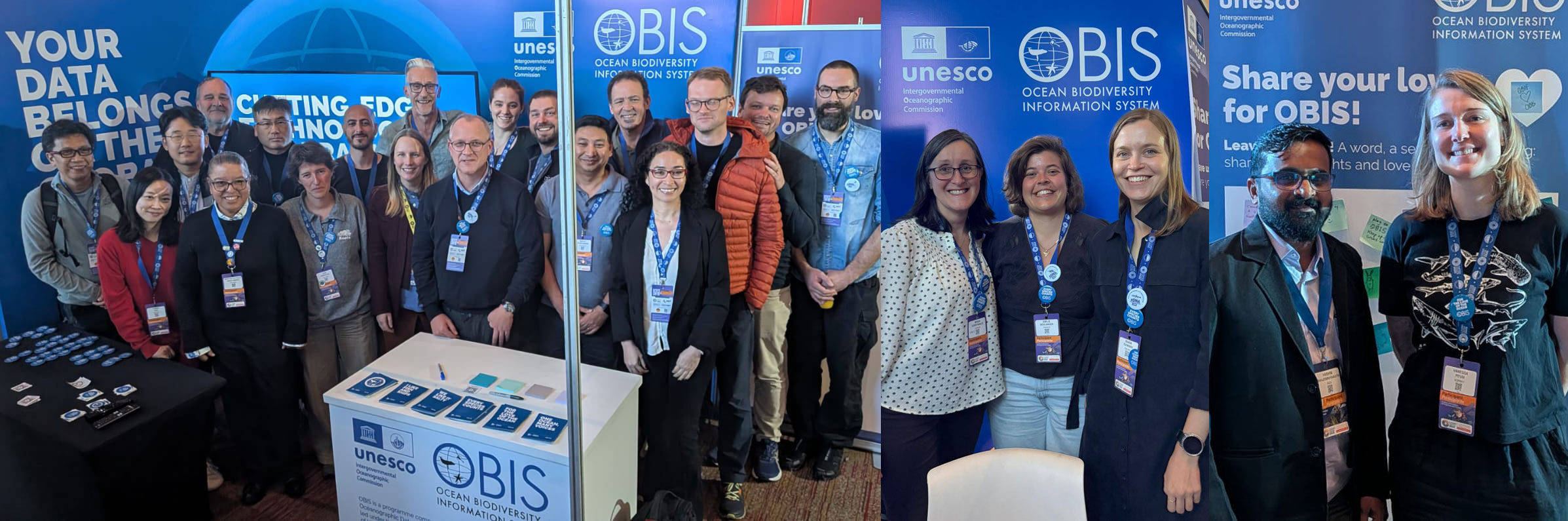 The OBIS representatives at Living Data 2025. Photo: OBIS
Living Data 2025, the first global conference on biodiversity data, took place in Bogotá, Colombia, from 21-24 October 2025. Co-organized by the Global Biodiversity Information Facility (GBIF), the Biodiversity Information Standards (TDWG), the Group on Earth Observations Biodiversity Observation Network (GEO BON), and OBIS, the event gathered over 1,000 participants, with 750 attending in person and hundreds more online. The conference was a significant milestone for the global biodiversity data community, acting as a platform for strengthening collaborations, highlighting interconnections, and inspiring cooperation. For OBIS, Living Data 2025 was an exceptionally rich and fruitful experience. With two booths—one for OBIS and one for the eDNA Expeditions project, supported by Minderoo Foundation and led by OBIS—alongside more than 15 co-led sessions and numerous presentations, OBIS demonstrated its global influence and significant role on the biodiversity data stage. In this article, we give you a front seat to Living Data 2025 and share five key takeaways from the event. You can click on each session or presentation to watch the corresponding video, when available.
Takeaway #1: Data depends on people
At a time when AI has become a powerful and ubiquitous buzzword, often stealing the spotlight, Living Data 2025 placed the people behind datasets at the centre stage. Global biodiversity data systems are powered by people working for the common benefit of nature and humanity. With over 6,000 contributors worldwide, OBIS recognizes that people, skills, and community empowerment are key to data accessibility. At the conference, OBIS emphasized that investing in people through training and capacity development is fundamental for accelerating data mobilization and increasing global contributions.
Across the entire data cycle, from fieldwork to remote sensing and modelling, scientists worldwide collect, prepare, verify, and curate biodiversity data. Public participation and citizen engagement can further support these efforts. Humans are the origin, the enabling force, and one of the beneficiaries of the biodiversity data value chain. Scientists and citizens make data actionable for decision-makers whose choices influence the livelihoods and well-being of communities, professionals, and citizens. Ultimately, humans connect technology, data, science, and action, ensuring that knowledge-based impact benefits nature and people.
Related OBIS sessions and presentations:
→ Community Engagement and Capacity Building for Increased Biodiversity Data Accessibility (Part 1 and Part 2) by Maheva Bagard Laursen, Katherine Tattersall (OBIS Co-Chair/OBIS Australia), Elizabeth Lawrence (OBIS Secretariat), and Mélianie Raymond
→ Building Capacity for Marine Biodiversity Data Sharing: Reflections from the Marine Biological Data Mobilization Workshops by Ana Carolina Peralta (OBIS Caribbean Node Manager), Jonathan Pye (OBIS Product Coordination Group Co-Chair), Tim van der Stap, Elizabeth Lawrence, Laura Brenskelle, Tylar Murray, Mathew Biddle (OBIS USA), and Stephen Formel (OBIS Secretariat)
→ The Power and Pitfalls of Civic Science by Dan Lear (OBIS Co-Chair/OBIS-UK), Ruben Perez Perez (OBIS Data Coordination Group Co-Chair), and Ely Wallis
→ Globally Trusted Data for Ocean Conservation, Management and Biodiversity Action by Ward Appeltans (Head of the OBIS Secretariat), Laurent Chmiel (OBIS Secretariat), Dan Lear, and Katherine Tattersall (video unavailable)
→ From Shore to Server: Connecting Marine Civic Science to Global Biodiversity Data through DASSH and OBIS-UK by Chloe Figueroa Ashforth (OBIS-UK), Julie Bunt (OBIS-UK), Dan Lear
Takeaway #2: Working together to accelerate data mobilization
Living Data 2025 demonstrated how coordinated joint efforts between networks, communities, and initiatives across disciplines and regions accelerate data mobilization and improve interoperability. OBIS, together with GBIF, GEO BON, and TDWG, showed that a common vision, shared standards, and a consensus-based approach are essential to improve biodiversity data mobilization and accessibility. From developing data publishing capacity through adapted collaborative strategies to encouraging regional networks, OBIS participates in these worldwide efforts to transform local data holders into global contributors across biodiversity data systems. Living Data 2025 also illustrated how a single global conference, co-organized by four major global biodiversity data organizations, could draw together in one shared space diverse communities that could exchange, interact, and learn from each other.
At the conference, collaboration among major global biodiversity data initiatives stood out as a key enabler for advancing ecosystem knowledge. At Living Data 2025, OBIS and the Global Biodiversity Information Facility (GBIF) renewed their partnership. They reconfirmed their Joint Strategy for Marine Biodiversity Data (2025–2030), aiming to make marine biodiversity data more interoperable, accessible, and actionable for science and decision-making. Capacity development initiatives remain a central pillar of that collaboration.
Cross-disciplinary collaborations also took a large space at Living Data 2025. In one of the flagship sessions, OBIS, together with the Global Ocean Observing System (GOOS), the Marine Biodiversity Observation Network (MBON), and GBIF, highlighted the need for a collaborative, holistic approach to bridging marine knowledge gaps. The session showed how combining biological, biogeochemical, and physical observations can transform our collective capacity to observe and understand the ocean. This integrated perspective is reflected in the OBIS and GOOS collaboration under the Intergovernmental Oceanographic Commission (IOC) of UNESCO. The joint effort aims to operationalize the Essential Ocean Variables (EOVs), a core and crucial set of measurements needed to observe the state of marine biodiversity and monitor its changes through key indicators, from microbes to mangroves.
Regional cooperation plays an equally crucial role in data mobilization: shared challenges, culture, and approaches encourage cooperation, driven by a common interest in finding solutions. At Living Data 2025, initiatives such as the OBIS Network for Latin America and the Caribbean (OBIS-LAC) and the EurOBIS & EMODnet Biology cooperation showed how they address specific local needs by lowering publication barriers, preventing data silos, and unlocking shelved datasets. Initiatives such as the Marine Biological Data Mobilization Workshops further support regions in building the skills they need. Together, these efforts create coherent value chains, with solutions adapted to specific contexts, and illustrate how capacity development leads to data mobilization, crucially transforming local holders into global contributors.
Related OBIS sessions and presentations:
→ OBIS Capacity Development Initiatives in light of the OBIS-GBIF Strategy by Ana Carolina Peralta and Elizabeth Lawrence
→ A Global Ocean Biodiversity Observing System supporting governance framework implementation by Ward Appeltans (Head of the OBIS Secretariat), Andrew Rodrigues, Emma Heslop, Audrey Darnaude, Frank Muller-Karger
→ EurOBIS & EMODnet Biology as two of the driving forces behind marine biodiversity data capacity building within Europe by Leen Vandepitte (EurOBIS Node Manager), Cyril Radermecker, Lynn Delgat, Joana Beja, Ruben Perez Perez
→ Developing capacity through regional cooperation: how regional hubs enhance local scientific voices by Laurent Chmiel (OBIS Secretariat), Ana Carolina Peralta (OBIS Caribbean Node Manager), and Ruben Perez Perez, with added panelists Martha Vides Casado (OBIS Colombia) and Erika Montoya Cadavid (OBIS Colombia).
Takeaway #3: The need for trusted data to support action
Numerous sessions and presentations at Living Data 2025 highlighted the crucial role of data integration components, from standardization efforts to the application of FAIR and CARE principles, and the need for robust Quality Control processes. Ready-to-use, fit-for-purpose, high-quality biodiversity data contribute to sustaining emerging monitoring systems and approaches, such as remote sensing and model-based predictions, and support for conservation actions. For OBIS, providing trusted data is fundamental to building confidence in its services, driving uptake of its products, and ensuring their adoption by end-users. Users need confidence that the data they access comes with full transparency, provenance tracking, and visible Quality Control mechanisms that guarantee reliability and relevance.
Beyond trust, biodiversity data should provide contextual elements to better inform decision-makers. At Living Data 2025, OBIS showed that its data can give additional context to observations, such as linking marine species and their habitats, providing Extended Measurement or Fact values, or adding complementary data types to datasets. This enriched information helps users understand changing ecological patterns and efficiently supports evidence-based decisions, marine spatial planning, and progress tracking at all scales. At the conference, OBIS demonstrated its operational maturity by showing how its contributions power data flows and how its services and products support organizations, conservation frameworks, and decision-making worldwide.
Related OBIS sessions and presentations:
→ Enhancing Data Policy & Biodiversity Monitoring: Quality, Gap Analysis & Environmental Integration by Clara Baringo Fonseca (OBIS Brazil), Keila Macfadem Juarez (OBIS Brazil), Silas C. Principe (OBIS Secretariat), Pieter Provoost, Maria Cornthwaite (OBIS Canada), and Jonathan Pye
→ Beyond Species Occurrences: Harnessing eMoF Data for Marine Biodiversity Science by Elizabeth Lawrence and Silas C. Principe
→ Linking species and habitat observations: Cross-Thematic Integration in EMODnet for Context-Enriched Marine Biodiversity Data by Ville Karvinen, Joana Beja, Leen Vandepitte, Ruben Perez Perez, Bart Vanhoorne, Graeme Duncan, Hellen Lillis, and Dan Lear
→ Integrating (and increasing the use of) additional data types by Silas C. Principe, Elizabeth Lawrence, and Ruben Perez Perez
→ Opening new frontiers with near-real time biological ocean data by Jonathan Pye, Ian Jonsen, Clive McMahon, Ward Appeltans, Elizabeth Lawrence, Ana Lara-Lopez, Audrey Darnaude
→ Ocean data application for biodiversity-inclusive Marine Spatial Planning by Silas C. Principe, Pieter Provoost, Ward Appeltans, the MPA Europe team, Anna Addamo, and Mark Costello
→ Trust, Traceability & Transparency: Tackling biodiversity data provenance by Dan Lear, Elizabeth Lawrence, and Pieter Provoost (OBIS Secretariat)
→ Matching decision-making needs with actionable data products to drive biodiversity monitoring impact by Steve Formel, Laurent Chmiel, and Silas Principe (video unavailable)
Takeaway #4: Innovation for radical impact
As conservation needs evolve and ecological pressures intensify, the biodiversity data community is developing innovative tools and approaches to strengthen impacts. At Living Data 2025, OBIS demonstrated how mobilizing cutting-edge technologies like environmental DNA and predictive models helps to maximize marine biodiversity data’s reach, relevance, and impact. The emergence of these new observing tools calls for creative approaches to integrate data quickly and ensure seamless interoperability with existing systems while ensuring attribution to the data providers. Beyond technology, co-designed workflows, improved data processes, and simplified data pathways are significant drivers to support efficient uptake.
At the conference, OBIS showed that eDNA can accelerate the scale, frequency, geographic coverage, and accessibility of marine biodiversity observations and sustain the development of resource-adapted, cost-efficient, local biorisk mitigation mechanisms. OBIS also demonstrated how leveraging advanced models to turn data into high-resolution decision-support tools makes complex data more accessible, interpretable, and actionable for conservation. Open publishing of innovative tools supports reuse globally.
Related OBIS sessions and presentations:
→ A multi-evidence approach for flagging taxonomic misidentifications in marine eDNA metabarcoding datasets by Pieter Provoost, Saara Suominen (OBIS Secretariat), Silas Principe, Ward Appeltans
→ Integrating DNA Reference Databases and Molecular Taxon Concepts in Biodiversity Databases by Urmas Kõljalg, Emilie Boulanger (OBIS Secretariat), Tobias Frøslev, Rutger Vos, and Pieter Provoost
(video unavailable)
→ eDNA Expeditions - Scaling Biodiversity Monitoring Globally Through Community Science by Saara Suominen, Pieter Provoost, Silas Principe, and Ward Appeltans
→ From Observation to Impact: Co-created tools emphasize the role of data management in global biodiversity observing systems by Elizabeth Lawrence and Lina Mtwana Nordlund
→ Improving data management strategies, sharing, and FAIRness of DNA-derived Biodiversity Data, Part 2 (Part 1 is unavailable as video) by Saara Suominen and Erika Montoya Cadavid (OBIS Colombia)
→ Bridging the Gap: Simplifying Metadata Flows with an EOV Application by Elizabeth Lawrence
Takeaway #5: We need global collaboration on biodiversity data
Living Data 2025 demonstrated the energy, commitment, and collective power of the global biodiversity data community. It showed how essential biodiversity data has become for addressing the interconnected crisis of climate change, biodiversity loss, and pollution. This collaboration between organizations amplifies impact and accelerates progress towards more accessible, interoperable, and actionable biodiversity data for science and society. To build on this momentum, we need more shared forums and events where organizations, researchers, and decision-makers can come together, step back, listen, and reflect on the achievements across disciplines, realms, and regions. These dedicated spaces would strengthen mutual understanding and align a collective commitment to a common goal: mobilizing data for a better planet.